

Are Bitcoin fund managers facing a threat from quantum computing?
The short answer is yes — but solutions are emerging, and there is still time to prepare.
One such solution involves post-quantum Bitcoin transactions on the mainnet, and the Starknet Foundation facilitated the very first one this week.
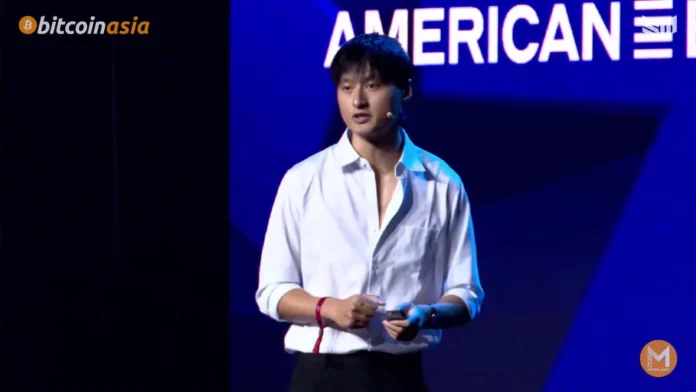
During an appearance on Thursday at Bitcoin Asia in Hong Kong, Damian Chen, the VP of growth at the Starknet Foundation, showcased a newly developed method by the company to secure funds susceptible to potential quantum attacks without needing a network-wide fork.
“This is a monumental moment,” Chen stated. “Это is the first post-quantum-resistant Bitcoin transaction on bitcoin mainnet today. It required no soft forks; it required no hard forks; it required no core protocol upgrades, and it’s live today.”
The transaction utilized a technique designed by Avihu Levy, a researcher at StarkWare. The mechanism functions because Bitcoin transactions spend a brief period waiting in a public queue prior to confirmation. During this interval, they reveal cryptographic information that an advanced quantum computer could exploit to forge a signature and steal funds before validation occurs.
Rather than accepting the initial valid signature, Levy’s approach generates millions of potential signature candidates until discovering one with a precise structural property that avoids exposing this vulnerable data while sitting in the mempool.
Referred to as “signature grinding,” this procedure is intentionally resource-intensive, taking hours to generate a single transaction, though that exact expense provides resistance against quantum shortcuts.
Promoting these quantum-safe Bitcoin transactions, known as “QSB,” to institutional investors, Chen explained that attackers possessing a fund’s private keys would still be unable to execute a fraudulent transfer.
“QSB introduces a new hash authorization, and so an attacker with a sufficiently capable computer, even if they have your exposed public key, even if they derive your private key from your public key, even if they try to use that to authorize a spend to move your coins out of your wallet, those things are not enough for them to do so,” he noted.
Standard Bitcoin nodes currently do not recognize this non-standard transaction format, meaning it could not enter the public mempool and instead had to be delivered directly to a willing miner. The mining enterprise MARA and its Slipstream service ultimately processed and mined the QSB transaction.
Quantum researchers have previously cautioned that Bitcoin’s software—which secures the largest and most robust computing network globally—will eventually require upgrades to address quantum computing threats.
While certain crypto venture capital firms have pushed for immediate action, prominent Bitcoin developers contend that existing quantum computers possess limited capabilities and have only accomplished minor computations.
Nevertheless, developers acknowledge that technological progress could advance unexpectedly, much like recent strides in artificial intelligence, and they have begun formulating prospective defenses.
Chen concluded: “The question to me has never been when will quantum arrive. We all know quantum will arrive at one stage, but the question to me has always been, how long will it take for you to be ready when quantum does arrive?”
FAQ
What is a quantum-safe Bitcoin transaction?
It is a transaction designed to resist potential future decryption and signature forging attempts by powerful quantum computers.
Did this transaction require a Bitcoin protocol upgrade?
No, it was completed without any soft forks, hard forks, or core protocol upgrades.
How does signature grinding work?
It is a computationally heavy process that generates millions of signature candidates to find one with specific structural properties that hide vulnerable data in the public queue.
Who mined the first transaction?
It was mined using the Slipstream service provided by mining company MARA.