
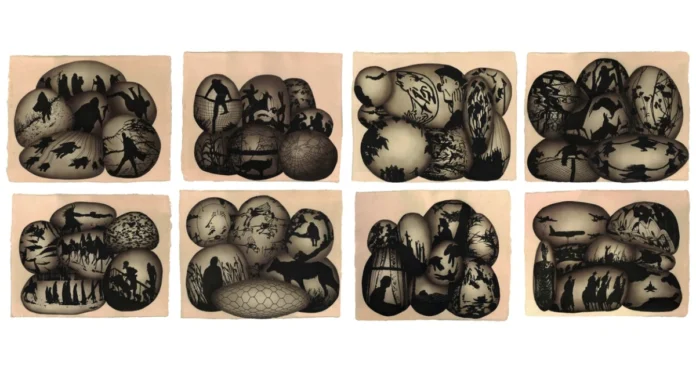

In 1915, Kazimir Malevich hung a black square on a gallery wall, designating it the zero point of painting — the end of the image presented as an image. A little over a century later, the black square returns in Remains, though this time as a consequence rather than a statement. If a collector of one of these works by artist Rupture takes no action, the on-chain response will generate the black square for them, erasing the image one pixel and one block at a time until nothing remains.
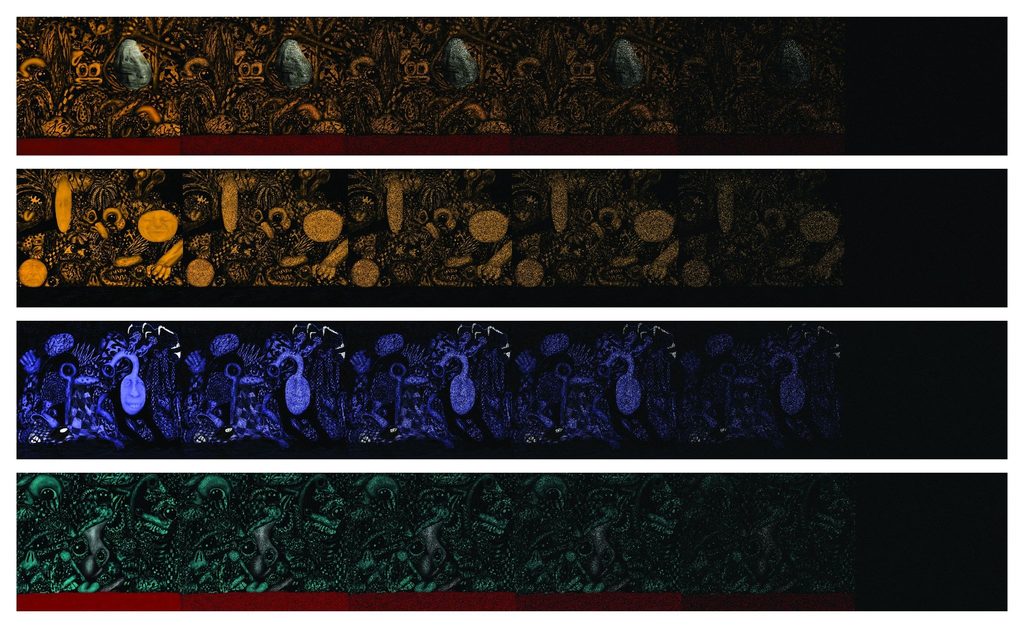
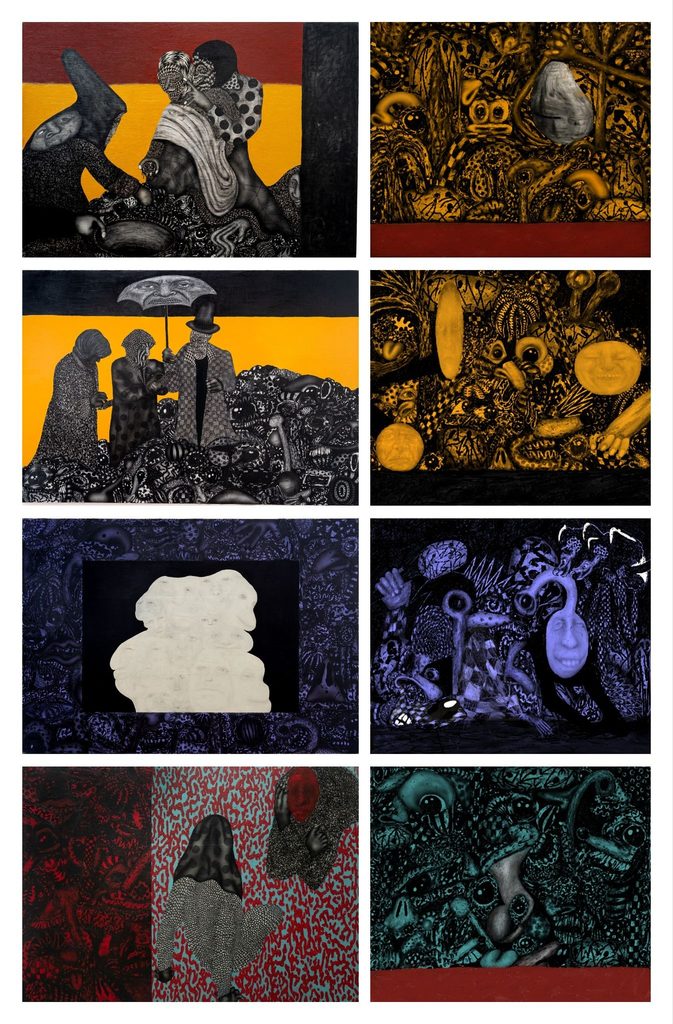
Remains comprises four hybrid pieces that structurally link a physical painting with a related ordinal. Each inscription contains precisely 210,000 pixels, matching the number of blocks mined during a bitcoin halving epoch. Starting at the upcoming halving in April 2028, the inscription begins real-time decay, losing one pixel for every block the network mines. Halting this process requires a unique alphanumeric code hidden beneath the physical painting’s surface. Retrieving it demands destroying a meaningful portion of the artwork, which must then be inscribed as a “child” of the ordinal to permanently stop the decay. Preserving the painting means letting the blockchain consume the image, while saving the inscription leaves the physical work permanently damaged. Because inaction remains a choice, collectors cannot stay passive, and the Bitcoin blockchain records both permanent outcomes.
Art history frequently employs destruction as an artistic gesture. In 1953, Robert Rauschenberg erased a de Kooning drawing and framed the blank space. At Sotheby’s, Banksy passed Girl with Balloon through a shredder hidden inside its frame the moment bidding closed. Later, in 2016, Sun Yuan and Peng Yu placed an industrial robot inside a Guggenheim cage with a singular objective: endlessly sweeping blood-red fluid back toward its base. The machine performed this repetitive self-maintenance for three years until it visibly slowed and ultimately stopped. Can’t Help Myself might be the saddest machine ever created, serving as a close predecessor to Remains since both operate on a timeline and force viewers to watch real-time decay. However, while the robot’s fate was fixed by programming, Remains leaves the final outcome unwritten, shifting destruction from an artist’s spectacle to a collector’s act of stewardship.
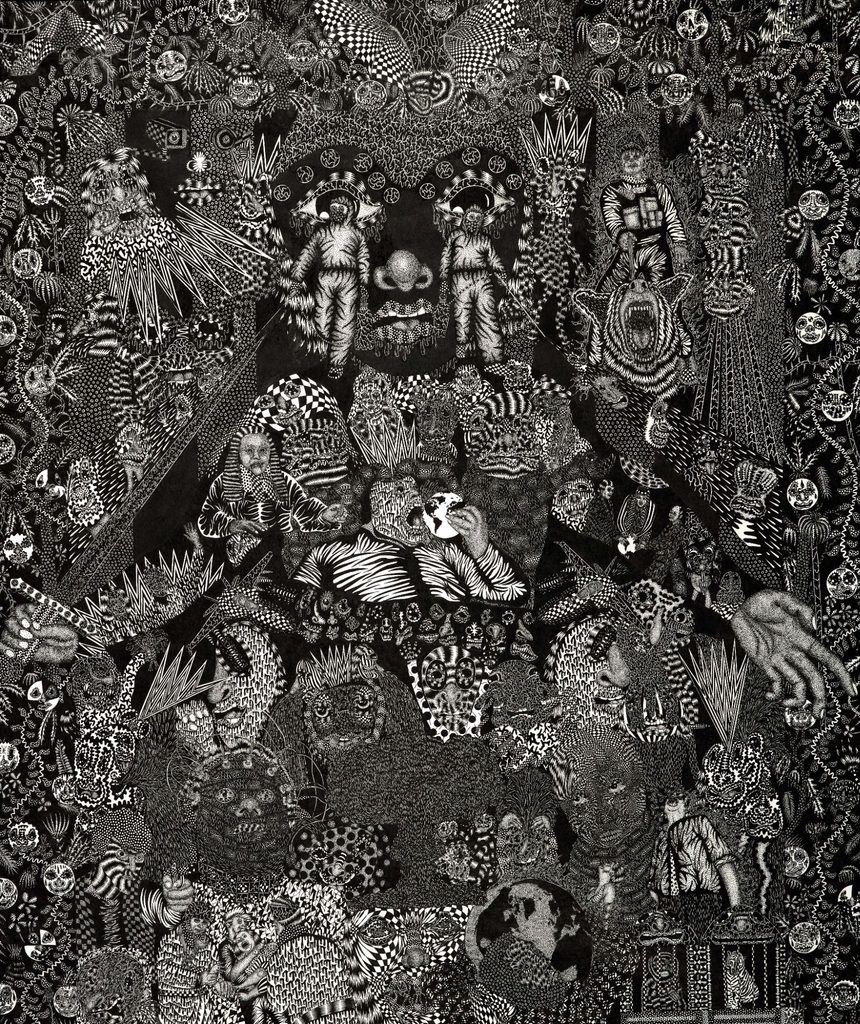
Born in Switzerland in 1993, Rupture is a self-taught artist based in Mexico City. Within the digital art space, he has created the Persona series (750 works, 2024–2025), which stands as one of the most widely collected artist-made bodies of work on Bitcoin. He also produced earlier projects on Ethereum and was among the first artists to release work on Solana. His physical practice extends further back, featuring international exhibitions since 2016 at the Museum Halle Saint-Pierre in Paris, Art Basel Miami, and the 2nd Triennial of Self-Taught Visionary Art in Belgrade, alongside a nomination for the Prix Suisse d’Art Brut. His figurative paintings rely on dense, obsessive mark-making and an emphasis on irreversibility. Remains merges these two paths, binding painting and blockchain into single objects where each remains incomplete without the other.
Bitcoin functions as the digital age’s most significant permanence system, operating on the premise that recorded data cannot be lost. Remains puts that architectural assumption to the test, exposing a core asymmetry between physical and digital culture: physical culture naturally forgets, whereas digital culture records permanently regardless of intent.
I sat down with Rupture prior to the exhibition to discuss decay as a medium, the forced participation of collectors, and the true cost of preservation.
BMAG: Let’s start with the mechanism, because it’s the basis of the whole series. Each digital component contains exactly 210,000 pixels – the number of blocks in a Bitcoin halving epoch – and beginning at the April 2028 halving, one pixel dies for every block the network mines. Discuss how you arrived at that structure. Did the concept come first and the math followed, or did the number 210,000 suggest the work?
Rupture: The concept was there before any of the pieces existed. I was thinking a lot about permanence, especially in relation to digital mediums. Bitcoin is seen as the most permanent and unchangeable record humanity has built, and Ordinals were marketed on exactly that thesis – a truly permanent storage layer, unlike NFTs on other chains with their broken links and files sitting on someone’s server. Persona, my first series on Ordinals, embraced that promise. With Remains I wanted to turn it on its head.
I think there is something beautiful about impermanence. We live in a moment where movements like transhumanism want to engineer it away, and I understand the impulse, but I’d argue the opposite: life would lose its meaning if it were eternal. The same applies to art. Tibetan monks spend weeks building a sand mandala and then sweep it away – the dissolution becomes part of the work.
So I set out to make a digital work that would be consumed by Bitcoin’s own metabolism. From there the structure basically assembled itself. The closest on-chain analogue to a pixel dying was a block being mined – a discrete, irreversible event that happens roughly every ten minutes, forever. So I linked them one to one. An epoch is 210,000 blocks, which meant the image had to be 210,000 pixels. The math followed the concept.
BMAG: The “kill switch” is hidden beneath the paint on the physical painting. To retrieve the code that stops the decay, the collector has to destroy a meaningful portion of the physical work – and then inscribe it as a child of the Ordinal. Did you paint these differently knowing the surface is also a type of vault? It’s very taboo to touch (or cut) a painting (outside of Lucio Fontana).
Rupture: I tried to approach these the way I would approach any other painting. The only real difference is that I had to start with the code. Each one was written on paper, laminated, and sealed at the center of the panel under layers of molding paste and gesso. Only then could the painting begin. So the secret is literally the first layer. Everything else sits on top of it.
As for the taboo – I think most of us, me included, are conditioned to ascribe a much higher value to the physical object. The painting feels irreplaceable in a way the inscription doesn’t, even when the inscription is the scarcer thing. That conditioning is what makes the concept work. The taboo gives the act of destruction its emotional weight, and that weight is what the collector has to sit with.
I deliberately left it open-ended. I’m not telling anyone what the right choice is. The collector confronts the question of value and permanence and answers it for themselves – publicly, and only once.
BMAG: There’s a lineage of destruction in art – Rauschenberg erasing de Kooning, Tinguely’s self-destroying machine at MoMA, Banksy’s shredder at Sotheby’s. And more recently, the “burn a physical to mint a digital” gesture that flared up during the initial NFT boom. Remains feels like a response to that last one in particular: in your work, destruction isn’t a spectacle the artist performs – it’s a responsibility the collector inherits. Where do you place yourself in that lineage, and what do you think the burn-to-mint era got wrong?
Rupture: I like to think of destruction as integral to creation. Jasper Johns destroyed nearly everything he made before 1954 so he could start over. Agnes Martin did the same, more than once. So artists questioning the preciousness of the art object is nothing new. And I think that preciousness is inherited – art objects have absorbed the aura that used to belong to relics. Now that commodities are the closest thing we have to a religion, cutting open a painting might be our version of desecration. Which is exactly why it carries weight.
The burn-to-mint mechanic treats the physical as a husk. You burned the painting to “upgrade” it into a token, the destruction was filmed, and the spectacle was the marketing. What it got wrong, I think, is that nothing was actually at stake. You destroyed something to get something the market valued more. That’s more of a transaction than a sacrifice.
In Remains there’s no version where you come out ahead. The collector already owns both halves, and destruction doesn’t produce anything new, it only decides which loss to accept. The loss runs on Bitcoin – a system built for remembering, repurposed as an engine of forgetting.
BMAG: The press text says the collector cannot remain passive – that inaction is itself a choice. That’s a strong tenet of the bitcoin idea. Self-custody works the same way: hold your own keys, and doing nothing is perhaps the best outcome. Did you set out to build a custody parable of some kind, or did the parallel arrive after? Artmaking can sometimes be nonlinear and we don’t see the connections in order.
Rupture: The parallel only occurred to me after the work existed. And funny enough, Remains actually inverts the rule. In self-custody, doing nothing is the safe move, while for Remains, doing nothing is what kills half the work.
But the deeper thing is the same in both. You’re on your own. There’s no institution behind you, no support line, no one to make the decision for you or undo it afterwards. The system just records what you do, and there are no exceptions.
Most people have never owned anything under those conditions. Bitcoiners have. I think that’s why they tend to understand this work faster – they know what it feels like to be the only one responsible for something that can’t be undone.
BMAG: At the next halving, the decay clock starts for any un-rescued work. Anyone can watch the inscriptions on-chain as they change. Is a completed black square a failed Remains, or the most honest version of the work?
Rupture: It definitely isn’t a failed Remains. It’s the piece brought to one of its logical outcomes. The work was never meant to be just the image – it’s the image plus the decision, and a black square is what one of those decisions looks like. It means the collector chose the painting, whether out of conviction or paralysis, and the chain holds the receipt: 210,000 confirmations of a single choice, applied one block at a time over four years. I don’t know of another artwork that documents its owner’s decision at that resolution.
And then there’s the Malevich analogue, which you opened with. He declared the zero point of painting. Remains arrives at the black square instead of starting from it – block by block, with an exit available the entire time. I don’t know which of the four pieces will end there, if any. That’s the one part of the work I can’t determine.
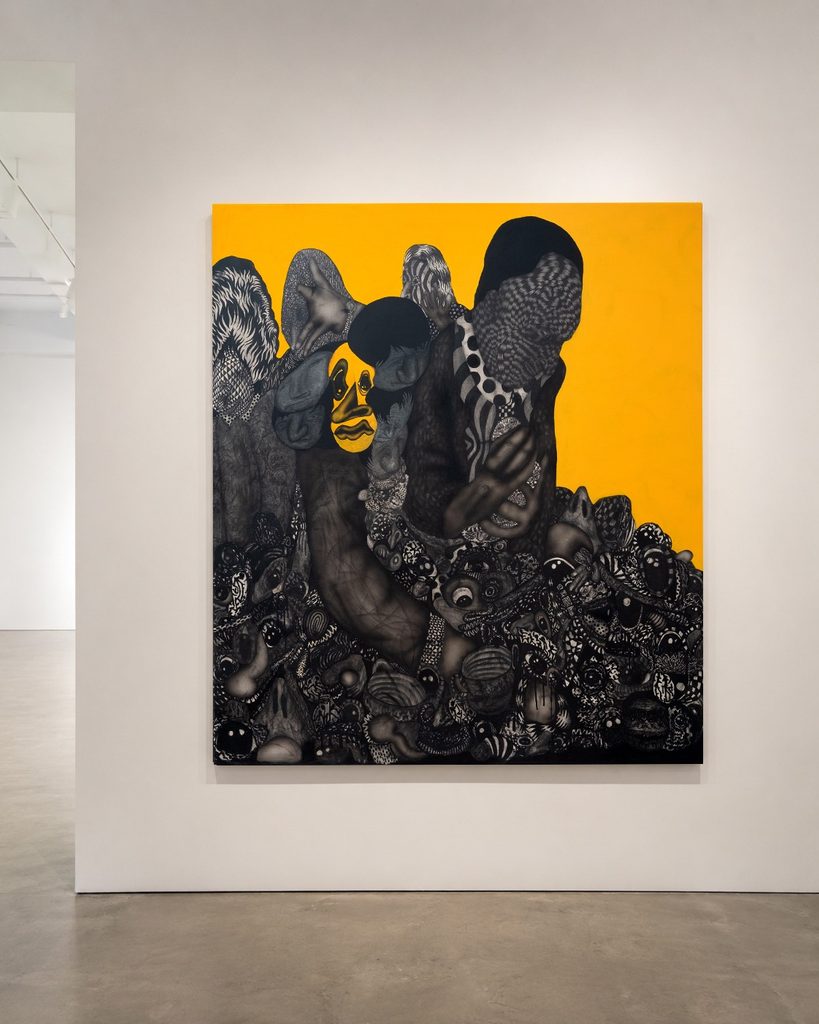
BMAG: For someone standing in front of these four paintings at the exhibition – someone who knows bitcoin as a price ticker but has never thought about what permanence actually costs – what do you want them to walk away thinking about?
Rupture: How permanence is never free. Nothing survives by default. Every object in every museum is there because someone paid for it to be – in money, in labor, in space, in other things thrown away to make room. History isn’t just what happened. It’s what someone decided was worth keeping. What persists does so because something else was set aside or destroyed. We just rarely see the other half of the equation.
Remains by Rupture debuts September 2–8, 2026 at PRIV.Y Gallery, 46 Hester Street, New York, presented by BMAG and running parallel to NFT.NYC. The opening reception is September 2. RSVP at luma.com/cckjg9kl.
BMAG is also running a bounty on X: enter for a chance to win Memory Theatre VI, an original work by Rupture. Full details and entry at shop.museum.b.tc/items/memory-theatre-vi.
Remains is now available to preview at https://shop.museum.b.tc/preview/remainsbyrupture. For acquisition inquiries, DM @BMAG_HQ on X or email bmag@btcmedia.org.
Follow Rupture on X @RuptureNFT.
The Bitcoin Museum & Art Gallery (BMAG) is the curatorial and cultural programming division of BTC Inc and the Bitcoin Conference. Learn more at museum.b.tc.
Frequently Asked Questions
What is Remains by Rupture?
Remains is a series of four hybrid works combining a physical painting and an on-chain ordinal inscribed with 210,000 pixels.
When does the digital decay begin?
Decay begins at the Bitcoin halving in April 2028, removing one pixel for every block mined unless stopped by the collector.
How can a collector stop the decay?
Collectors must destroy a portion of the physical painting to retrieve a hidden alphanumeric code, which is then inscribed as a child of the ordinal.
Where is the exhibition taking place?
Remains debuts from September 2–8, 2026, at PRIV.Y Gallery at 46 Hester Street in New York, presented by BMAG.