


Bitcoin’s roughly 50% decline from its October 2025 peak has provided a practical stress test for the institutional investment thesis. Making the case for a new asset is straightforward when prices are climbing, correlations are favorable, and capital is pouring in. The true test comes after a significant drawdown, giving investors an opportunity to re-examine their foundational assumptions and separate structural realities from the noise of the preceding cycle.
This is precisely the approach BlackRock takes in its recent research report, Re-Underwriting Bitcoin: Still a Portfolio Diversifier. Rather than viewing the recent market slump in isolation, the firm evaluates the question that matters most to capital allocators: how Bitcoin actually impacts the risk and return profile of a diversified portfolio.
The findings carry more weight than simple headline return numbers might suggest. In BlackRock’s rolling 10-year analysis ending May 29, 2026, a standard 60/40 equity and fixed-income portfolio delivered an annualized return of roughly 9.9% with an annualized standard deviation of about 10.1%. Adding a 1% Bitcoin allocation boosted the annualized return to approximately 10.9%, while volatility edged up only slightly to roughly 10.3%. With a 2% allocation, the annualized return climbed to about 11.8%, accompanied by a standard deviation of roughly 10.6%.
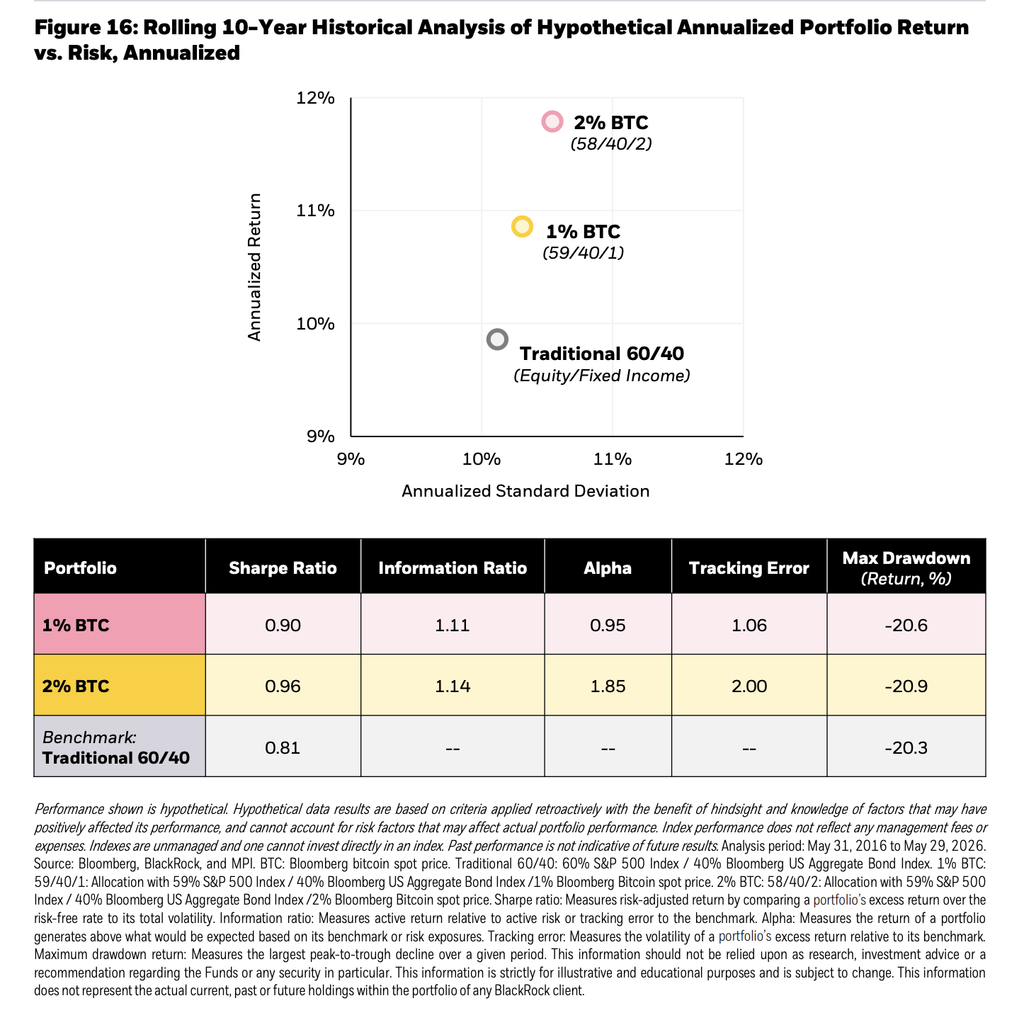
In other words, a 2% allocation delivered an extra 190 basis points of annualized return compared to the traditional portfolio while lifting annualized volatility by just 50 basis points. The overall Sharpe ratio improved from 0.81 to 0.96, and the maximum drawdown shifted marginally from -20.3% to -20.9%. While these metrics are hypothetical and backward-looking, they demonstrate why evaluating Bitcoin solely on its standalone volatility yields an incomplete picture of its role in a broader portfolio.
A more critical inquiry is how that volatility behaves alongside the rest of an investor’s holdings. BlackRock continues to view Bitcoin’s risk and return drivers as distinct from traditional assets, supported by its fixed supply, decentralized framework, and absence of a sovereign issuer. While these traits do not stop Bitcoin from trading alongside risk assets during widespread deleveraging events, BlackRock’s findings indicate that these correlations are generally episodic rather than permanent.
This dynamic helps clarify the portfolio outcomes. A small allocation does not translate Bitcoin’s standalone volatility into a diversified portfolio on a one-for-one basis. The key metric is the marginal contribution of that allocation to overall portfolio risk weighed against its historical returns. According to BlackRock’s study, that trade-off remained attractive at the 1% and 2% levels, even after factoring in one of Bitcoin’s steepest recent corrections.
Why 1–2% keeps appearing in BlackRock’s work
This is not the first time BlackRock has landed on this specific percentage bracket. Earlier portfolio studies assessed Bitcoin sizing through risk contribution, concluding that a 1% to 2% weight represents a sensible threshold for investors equipped to handle Bitcoin’s risk profile. At those levels, BlackRock calculated that Bitcoin contributes an equivalent share of total portfolio risk as a single mega-cap tech stock within a standard 60/40 model. Exceeding a 2% allocation, however, causes Bitcoin’s share of total portfolio risk to grow at an accelerated rate.
The updated research tackles the problem from the reverse angle. Instead of measuring how much risk Bitcoin introduces, it looks at what investors historically gained in exchange for taking on that extra risk. The boost in the Sharpe ratio—moving from 0.81 for the traditional baseline to 0.90 with a 1% allocation and 0.96 with a 2% allocation—indicates that historical incremental returns more than justified the elevated portfolio-level volatility.
This does not designate 1% or 2% as a universally optimal target, and BlackRock does not frame it as such. The appropriate exposure depends heavily on individual liquidity needs, investment timelines, governance rules, and risk appetite. Instead, the analysis establishes a much firmer analytical framework. The conversation can now focus on marginal risk, correlation, drawdowns, and portfolio efficiency rather than getting bogged down in a binary argument over whether Bitcoin is simply too erratic to hold.
BlackRock has also seen the demand firsthand
Another layer of BlackRock’s latest research is tied directly to the firm’s own market footprint.
BlackRock rolled out the iShares Bitcoin Trust (IBIT) in January 2024. Within less than a year, the vehicle amassed over $50 billion in assets, making it what BlackRock terms the fastest exchange-traded product launch in history, hitting that benchmark roughly five times quicker than the prior record holder.
Its market significance has expanded since then. BlackRock now highlights IBIT as the world’s largest and most actively traded Bitcoin ETP, noting that the fund emerged as the firm’s top revenue-generating ETF in 2025 despite competing against a global product suite numbering over 1,000 offerings.
Concentration levels within the U.S. spot Bitcoin ETF sector are similarly striking. Figures from Bitcoin For Corporations show that U.S. spot Bitcoin ETFs collectively manage approximately 1.25 million BTC, which accounts for nearly 6% of Bitcoin’s capped 21 million supply. IBIT alone commands roughly 775,000 BTC, representing over 60% of all Bitcoin held across the domestic spot ETF ecosystem.
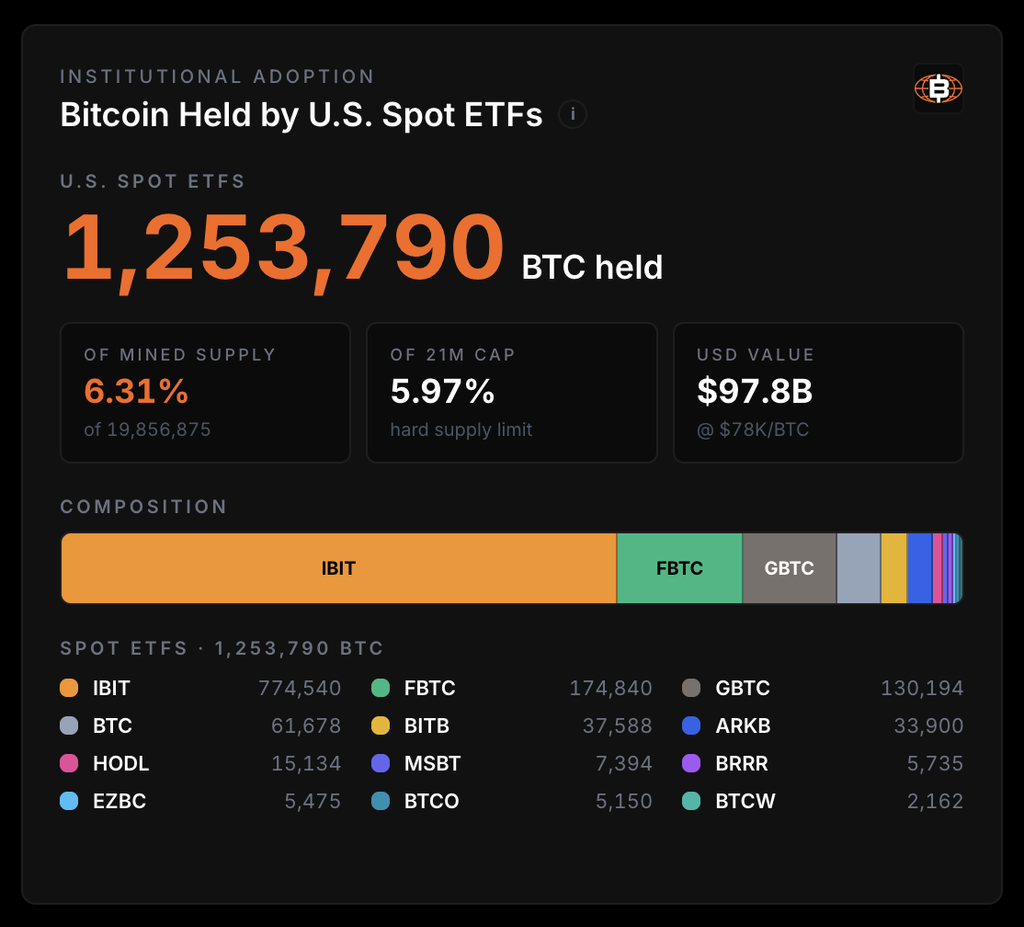
View the full Bitcoin ETF Dashboard.
This reality means BlackRock’s research cannot be viewed in a vacuum detached from commercial interests; IBIT is a major and growing asset for the company. Acknowledging that context is essential. At the same time, it means the firm’s re-evaluation is backed by more than two years of empirical observation regarding how investors actually deploy Bitcoin exposure at scale.
This distinction matters. The theoretical case for Bitcoin as an institutional portfolio holding is increasingly backed by concrete allocation trends. Investors have utilized familiar brokerage, advisory, and institutional structures to access Bitcoin across diverse market conditions, encompassing both aggressive rallies and sharp corrections. The expansion of IBIT indicates that demand has held firm well past the initial launch phase.
A drawdown is precisely when a thesis should be re-underwritten
The timing of BlackRock’s publication may ultimately offer more insight than the portfolio simulations themselves.
Bitcoin is not being re-evaluated during an all-time price high. BlackRock released the findings following a roughly 50% retracement from Bitcoin’s October 2025 peak—a phase the firm links to the unwinding of leveraged positions, slowing ETP inflows, and reduced accumulation from corporate treasuries. Its ultimate takeaway is that these pressures reflected a positioning adjustment rather than a structural failure of Bitcoin’s long-term investment narrative.
This is the core purpose of a re-underwriting exercise. An investment thesis should not endure simply because investors remain emotionally attached to it; it should endure because its underlying tenets remain sound when market environments shift.
For Bitcoin, those tenets go beyond past performance figures. The asset remains artificially scarce, globally liquid, independent of any sovereign government, and structurally distinct from the traditional liabilities filling conventional portfolios. BlackRock points out that growing anxieties regarding fiscal stability, monetary policy, and geopolitical volatility may only heighten the relevance of Bitcoin’s long-term adoption case.
The portfolio data does not guarantee future returns over the coming decade, nor does the success of IBIT dictate an ideal sizing strategy. Together, however, these developments signal a maturing institutional dialogue. Bitcoin is no longer judged strictly as a fringe asset that institutions may or may not choose to touch. Instead, it is increasingly scrutinized through the same rigorous lenses applied to traditional asset classes: sizing, risk contribution, correlation, liquidity, drawdown management, and expected returns.
What this means for corporate leaders
For corporate chief financial officers, board members, and executives, this structural evolution may represent the most vital takeaway from BlackRock’s research.
The central question is not whether Bitcoin is volatile—that fact is already well established. Nor does a corporate treasury allocation need to mirror the concentrated strategies adopted by firms that have built their entire balance sheets around the asset. A wide middle ground exists between holding zero exposure and operating a Bitcoin-centric balance sheet.
BlackRock’s study supplies a practical framework for navigating that spectrum. Even a modest allocation proved capable of shifting the historical return profile of a standard portfolio without triggering a proportional surge in overall risk. At a 2% weight, roughly 190 basis points of extra annualized return came alongside about 50 basis points of extra annualized volatility over the studied timeframe. The allocation footprint was small, but its impact was substantial.
For corporate decision-makers, the broader lesson is less about copying BlackRock’s exact percentage ranges and more about adopting the analytical discipline behind them. Bitcoin can be evaluated just like any other strategic asset allocation: define its strategic purpose, calculate an acceptable risk contribution, set clear liquidity and governance parameters, size the position appropriately, and review the underlying assumptions periodically.
That approach marks a significant evolution past the simplistic question of whether a business should simply “buy Bitcoin.”
As Bitcoin becomes more deeply embedded in institutional portfolios and financial plumbing, analytical standards are shifting. The core decision facing executive leadership teams is increasingly focused on what allocation, if any, aligns with the organization’s strategic goals, risk constraints, and cost of capital.
With its latest re-underwriting following a complete market cycle and a roughly 50% drawdown, BlackRock demonstrates that measured allocations to Bitcoin can still enhance portfolio efficiency. For corporate leaders, that is the core insight worth bringing into the boardroom.
What was BlackRock’s main finding in its updated Bitcoin research?
BlackRock found that adding a modest 1% to 2% Bitcoin allocation to a traditional 60/40 portfolio improved historical risk-adjusted returns and Sharpe ratios without drastically increasing overall portfolio volatility.
How did a 2% Bitcoin allocation affect a traditional portfolio?
In BlackRock’s rolling 10-year analysis, a 2% Bitcoin allocation added roughly 190 basis points of annualized return while increasing annualized volatility by about 50 basis points, raising the Sharpe ratio from 0.81 to 0.96.
Why did BlackRock re-underwrite Bitcoin after a 50% market drawdown?
Major drawdowns provide an ideal test to verify whether an investment thesis rests on structural foundations rather than temporary market hype, helping investors assess Bitcoin’s true portfolio behavior during stress.
How large is BlackRock’s iShares Bitcoin Trust (IBIT)?
IBIT accumulated over $50 billion in assets within its first year and holds approximately 775,000 BTC, making up over 60% of the total Bitcoin held across U.S. spot Bitcoin ETFs.